



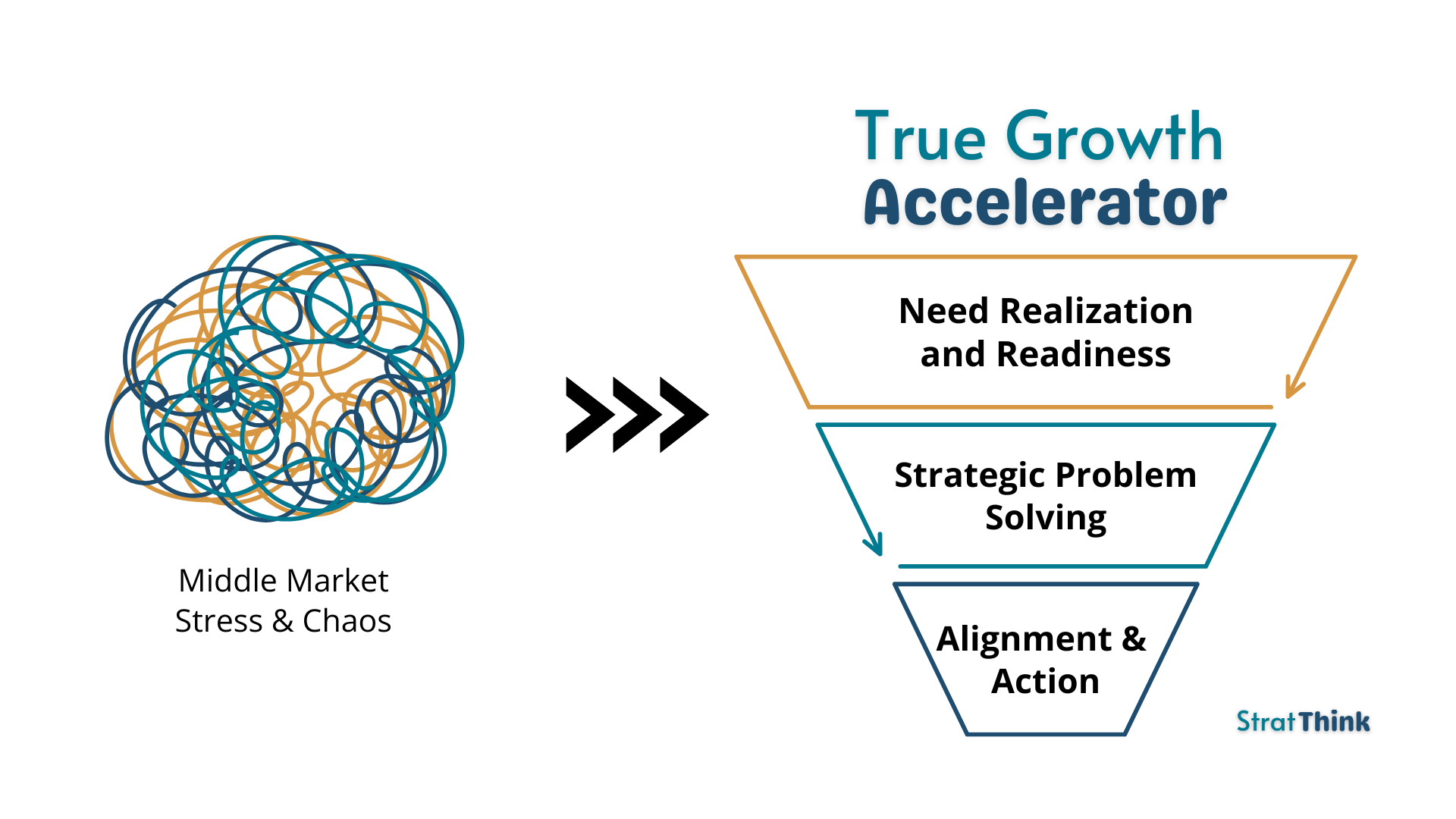
It is a major accomplishment for a business to enter the middle market. These businesses typically range between $10M and $1B in revenue annually, and hitting this milestone means you are a success. You’ve created, invested, or participated in a growth formula/plan that has taken you further than the vast majority of businesses go.
In Hollywood movies, this is the end of the story. All stakeholders ride off into the sunset on a very clear path where the sky is the limit.
But . . . Hollywood scripts are fiction for a reason.
Truth is, it is well recognized that this part of your story raises more questions, can cause dissent in the team, and, most unsettling, cast major doubts on your growth formula and plans that have gotten you this far. It can also be a time that feels chaotic, disorganized, and stressful, often like a jalopy just getting by.

We know this because we grew with a PE-backed, middle market company. We experienced the highs and lows. We saw:
The anxiety of trying to produce something new and sexy instead of building strong, quality deliverables
The continued use of “bandages” and cutting corners on issues that were infectious to the organization
Not putting the customer/end-user experience first
Overloading senior leadership so it was top-heavy and bloated, and under-supporting middle management and front-line employees
Not training and up-skilling middle managers so they could be effective in supporting and executing company initiatives
Not having a strong (or any!) growth strategy
It’s clear that a company can’t continue this way in the long run. Otherwise, it will only find unrealized growth, an unwelcome exit, or any number of outcomes you want to avoid.
So then, what to do?
At StratThink, we’ve faced this before in a variety of ways with a variety of industries. The answer is building a true growth strategy - which is not to be confused with a plan or the overuse of the word “strategy.” We call it “true” because it is, actually, a growth strategy that will generate the growth you’re looking for.
A true growth strategy will give you an unshakeable belief in its logic, executability, and its ability to deliver results. Beyond PowerPoints, spreadsheets, and PDFs, you’ll have self-efficacy about your future growth that will return you to the certainty you had before.
To get to that point, we follow our quarter-long process known as the StratThink Growth Accelerator.
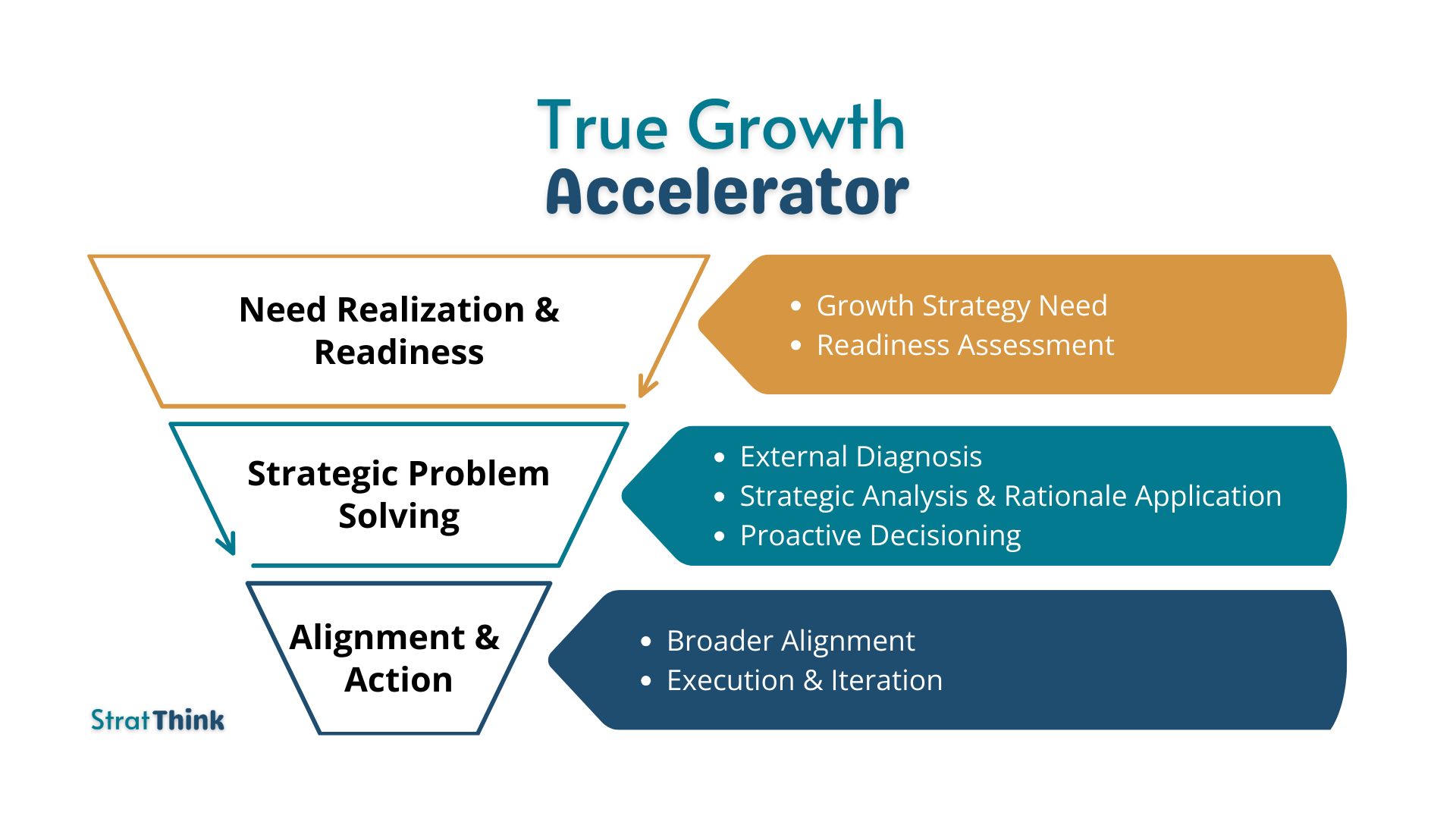
True Growth Strategy - Need Realization
You’re busy and under the pressure to deliver growth. This presents two threats to finding your true growth strategy: 1) Never realizing the true growth strategy need (“No Realization”) and 2) Failing to realize the extent of the true growth strategy need (“Low Realization”).
No Realization occurs when strategic triggers are ignored. These can include:
Missing goals consistently
Feeling like it takes all your time and effort just to maintain business as usual
Seemingly mysterious and consistent customer churn
Failure of new product adoption
It is easy in the day-to-day operations to feel and openly discuss these issues regularly without recognizing the need for a true growth strategy.
Low Realization occurs when you realize that there is no strategy or a non-producing existing strategy, but you underestimate what it takes to make a true growth strategy. This can look like:
Making changes from no or minimal market input (e.g., one client wants [x] feature, so let’s roll it out as a total product)
Ongoing white-boarding/brainstorming sessions with no meaningful changes afterwards
Monthly or quarterly leadership/executive sessions with constant reporting that don’t produce different results, even if it produces product and sales next steps
Revising executive leadership styles, mission statements, and cultural norms on a regular basis without it tracking to tangible results
Justifying bold, new changes based on market sizes and financial modeling alone
Following moves by competitors at almost each turn
Essentially, you know it is time to stop and think more holistically about what you are doing. But, when you do, it doesn’t actually produce choices or decisions that change the company trajectory and results.
Furthermore, you must manage this as a team and with stakeholders (e.g., fund investors). Therefore, you can be working with a mix of No Realization and Low Realization across all your interactions.
Rule of Thumb: A simple way to think about it is that if you and your stakeholders are giving operational answers to your strategy questions, then you don’t have the right level of true growth strategy need realization. If a critical mass of your stakeholders hasn’t switched from providing quick answers to a strategic curiosity, then you won’t find efficacy in your true growth strategy.
Solving Your Middle Market Growth Problem
Middle-market companies need thoughtful, objective business strategy and strategy alignment across the organization. If you go to ChatGPT, Google, LinkedIn, or the business section of Amazon . . . you’ll see a ton of ways to do this. This is the analytical muscle of getting to a strategy answer. There are frameworks, research methods, and key strategy questions everywhere.
At StratThink, we’re well-versed in all the tools and approaches. But trying to solve this type of problem - and leading your organization, day-to-day - can make it difficult to focus on, or prioritize, your true growth strategy.
Good, thoughtful business strategy looks like:
External Diagnosis
You built your middle-market company, and you love it. However, what you need right now is the most objective feedback and re-visiting of old assumptions that you can muster. It can be helpful to give current and former customers the space to be honest, respectfully remove personal connections to prior growth ideas (including the successful ones), and give due respect to industry changes, threats, and competitive changes. This is the time to get the most honest and research-backed point of view on how your industry works and your company’s positioning within it. With the cold facts, you have a great new base to re-create success.
Sound Strategic Analysis and Rationale Application
Here’s where your business acumen kicks back in. On the new facts, develop a new hypothesis for how your business can grow again and test it against what you found in the External Diagnosis. Consider what you would change, what would you keep the same, how have customer views shifted, what unmet needs have arisen, and how can you meet those needs from core operation or not. You also shouldn’t shy away from potentially reassessing your market ambition by recognizing that it needs to be met in a new way or that your original growth formula had a different revenue runway than originally contemplated.
Proactive Decisioning
In almost all cases, this should lead to discrete strategic choices that should feel like you are closing the door on one growth path for another. Often, there isn’t enough time or resources to choose all paths. These choices should have distinct risks, mitigations, and actionable next steps for the whole organizational to align with.
We won’t mislead you here. There are a lot of ways to do this, and it can get complicated in ways that are too numerous to list. But if you stick with it, you’ll get to a good answer.
Rule of Thumb: It is easy to either leave this step with weak enough choices, which feel like repacking business as usual, or with a feeling that the strategy should be even bolder or more disruptive. The best growth path is usually somewhere in between. If you apply sound rationale to good external diagnosis, you’ll find the best choices available.
Taking Companywide Action
But a good strategy does not exist in a vacuum – it’s not a static PDF that just the senior leaders and board are privy to. It’s a living, breathing structure that interacts with the organization on every level.
So, that means if the organization is a mess, then even the best strategies can only go so far. Your organization is the FOUNDATION for the effective execution of good strategy. Therefore, you’re going to need much broader alignment than just the C-Suite and the boardroom.
Consulting firms make their bread and butter on kickoff meetings, interim reports, and final reports. Of course, the process repeats for any follow-up that focuses on specific business units, departments, or functions/capabilities.
For us, we love to add a Strategy Summit at the right point of the process. This gets everyone in the same room to openly share problems and brainstorm solutions. The success of a summit is only as good as its implementation afterwards. You can brainstorm all the solutions you want, but if you do not structure and implement them, then the summit was done in vain.
At the summit, you want key operational stakeholders beyond the initial team that made your new growth strategy. This helps get everyone on the same page and smooth out any major operational blockers to prevent the true growth strategy from taking off. Teammates can ask questions, poke at rationale, highlight additional risks and mitigations, and leave more bought into the true growth strategy than if just a presentation or PDF was sent.
The summit will surface all the big issues and offer internal experience – as a data point – to further inform grander business strategy.
Execution and Iteration
A summit is a great first step to taking action, and it will be strengthened by a regular cadence of meetings to review KPIs, OKRs, and other materials necessary to keep a clear line of sight on strategy progress. The key is to have productive inquiry and meaningful collaboration to evolving issues, and to remove any “corporate theater” (as it’s described in Playing to Win: How Strategy Really Works) from your process.
Recap
Facing middle market challenges can be daunting. But it’s not the end of your story if you use the true growth strategy blueprint.
Growth Strategy Need Realization
Assess the status of your company for the presence of No or Low Realization.
Build a plan to increase this realization until key stakeholders and teammates are aligned to a total true growth strategy need.
Warning: If need realization drops at anytime, then the efficacy of your true growth strategy is at risk.
Solve Your Middle Market Growth Problem
External Diagnosis- This is the time to get the best “outside-in” point-of-view for everything. Look at everything with a new eye to accurately capture your industry changes, customer needs, and company positioning with each.
Sound Strategic Analysis and Rationale Application- Develop a hypothesis about how the business could change for growth and test it against your external diagnosis information. Let the rationale and data shape your next best idea.
Proactive Decisioning- Think through the choices, risk, mitigations, and next steps associated with those choices and choose the best path ahead.
Warning: The best path ahead is typically a reasonable and logical extension or new application of what you’re doing today. It does not have to be something “new and sexy.” It could be as simple as focusing on building strong, quality deliverables.
Taking Companywide Action (Strategy Summit)
Think about your expanded stakeholder group outside of the C-Suite and Boardroom/ Use a Strategy Summit to get everyone on the same page and highlight ongoing iterations to the strategy.
Warning: Not everyone takes this step. More traditionally, the action comes in the form of bold announcements, speeches, PowerPoints, and PDF distribution. Don’t make the mistake of being too top-down at this point. Organizational alignment is key to successful growth strategy.
Execution and Iteration
Establish an ongoing cadence to review KPIs, OKRs, and continual iterations needed to keep strategy momentum and to highlight any true growth strategy need realization.
Warning: Without follow-up, it is very easy for everyone to silo into their corners with the demands of their day-to-day responsibilities and to, altogether, forget about the true growth strategy. A follow-up cadence will build strategic execution muscle.
We’re confident the True Growth Accelerator can get you out of the pains of middle market growth and into being the effective, streamlined, profitable company you know is possible.
Hi! We’re StratThink! We help companies form a true growth strategy. Learn more about us and our approaches by subscribing!