



My business partner and I realized we had a major misunderstanding the other day.
We’ve been working together for about five years on all things strategy and organizational alignment, so we *seemingly* should understand each other’s perspective, pretty well.
But when we came upon a - quite sizable - misalignment in our understanding of each other’s perspective (and, therefore, our contributions to our company)…it was pretty eye-opening.
I was under the impression that business strategy inherently understood the crucial connection to organizational alignment and, therefore, would dedicate resources to implementing/executing/managing it.
Coming from my career of working with alignment issues, I thought, “Surely, aligning the strategy is a major consideration for organizations. Surely, an organization would understand the glaring pain points they’re experiencing are very often due to a rift between the designed strategy, the organizational reality, and the post-strategy alignment. Surely, this is an understood reality, right???!”
His response, “Nope - strategy alignment is a common problem in the strategy world.”
He even went on further to describe how some strategy approaches prefer to remain “elitist” - centered in the C-Suite and Corporate Strategy teams, but never moving much beyond those groups (nor seeking feedback from those outside the group).
I mean, I knew this - we’ve talked about strategy + organizational alignment ad nauseam before. But, I don’t think I understood the magnitude of the issue across the larger strategy culture.
Basically, what I’ve been experiencing from an organizational perspective is a larger strategy culture issue.
My business partner then sent me an article from MIT Sloan titled, “Turning Strategy into Results.” Though the strategy + organizational alignment topic is bigger than one article (and a continual, evolving discussion), I wanted to use this article now to highlight some of the strategy + organizational alignment dance - first, for me, and second, for you…if you so choose to accept this adventure. 🧝♀️
But if you go no further on this journey, please take away this one point: the process for the strategy/alignment dyad should be customized and go both ways, meaning, strategy creation should utilize both top-down and bottom-up feedback.
Overall, the best strategies I’ve seen shared a common trait: humility, especially the willingness to listen to multiple stakeholder groups. By contrast, some of the weakest strategies came from top-down C-suite leaders who seemed to make decisions in a bubble, often justifying their own authority (*cough* huge salary) while wasting significant company resources.
What is Strategy?
I love to start with a working definition so we have a foundational, collective understanding to build on. For the MIT Sloan article, the authors defined strategy as:
“Strategy, at its heart, is about choice…Most winning strategies are based on a bundle of choices about, among other things, the customers to serve, the scope of the business, product offerings, and capabilities that interact with one another to help a company make money.”
The article goes on to say that strategy is inherently complex, often being delivered in thick reports and complex frameworks. ← I’ve picked this up from clients who’ve worked with larger firms and often receive a large PDF with no implementation or follow-up alignment.
But - and get out your drool rags for good ole’ Megan over here - they wrote this beautiful gem-of-a-gem to sum up what I see and experience with strategy:
“Describing a strategy favors complexity, but executing it requires simplicity.”
Simplicity is key! I have seen, again and again, complexity take over EVERYTHING - operations, product, services, user-experience, sales, customer success, marketing, leadership.
Often, this complexity starts at the top and spreads throughout the organization like a virulent glitter.
Effective strategy creation + organizational alignment helps keep your organization moving together in a winning direction.
Simplicity helps so much with this goal.
🛑 Organizational alignment pit stop 🛑
So, how can we stop complexity from infecting the organization (like virulent glitter)?
We make a clear path from the company strategy to the remainder of the organization; if something is confusing or unclear, stop there and see what’s going on.
Confusion, friction, or lack of clarity is NOT always something to be pathologized - it can simply be a signal of misalignment or misunderstanding. Before taking it personally, try to identify what organizational elements are contributing to the situation.
Creating an Effective Strategy
What can help prevent some of the aforementioned alignment issues? Keeping the strategy as simple (and real) as possible. I say “as possible” because simple strategies do not work for all companies.
The article saw success with simple strategies if they “…focused on a single business, offered a standard value proposition to a clearly identified customer segment, and their strategy was stable over time.”
But, wait, didn’t you just say strategies are complex? You even had a meme about it…
I did! Because not all businesses are simple. You should always strive for as simple of a strategy as you can get, but business complexity makes strategy creation and execution more difficult. Therefore, aligning it broadly with the organization also becomes more difficult.
Additionally, there can be a real problem with creating effective strategies and strategic priorities. What do I mean by that?
Well, is your strategy fluffy or is it executable? Can it be broken into concrete steps and directives? Or is it a bunch of vague, feel good, no accountability, loose directives? See the chart below from the MIT Sloan article for an example of this:
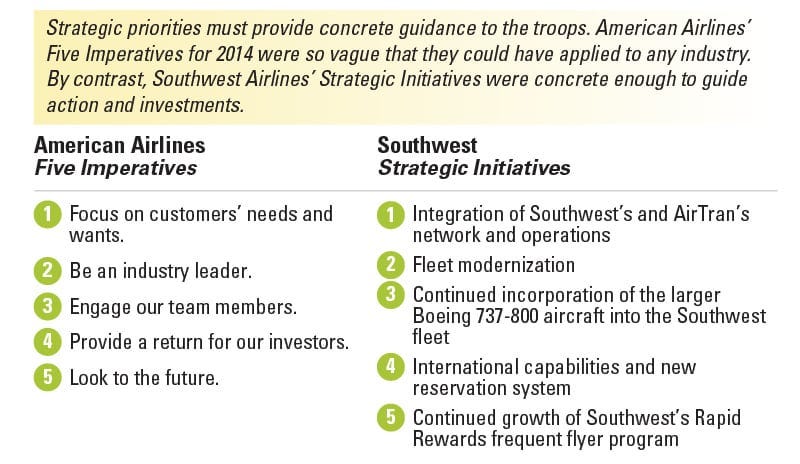
From an organizational alignment standpoint, it is a HECK of a lot easier to create alignment activity from a strategic priority like “Integration of Southwest’s and AirTran’s network and operations” versus “Focus on customers’ needs and wants.”
It’s not only easier to align, but it also helps with accountability. Not ‘heads will roll’ accountability, but a strategic goal that allows room for reflection and measurement, both along-the-way and when the strategic priority is achieved/not achieved.
We can say, “We were able to integrate Southwest and AirTran’s operations because of xyz. We were only able to integrate 60% of the networks because of xyz, and are still working on the last 40% of the integration after we address these [insert block(s) here].”
Unless we put clear performance indicators around “Focus on customers’ needs and wants,” it is less likely to be able to measure success, or failure.
Or, maybe we make a vague priority like this to avoid conflict.
Sadly, I see strategies like this all too often, which can result in - what I describe as - just moving food around the plate: never really making any decision, unless you absolutely have to, but looking busy enough that people think you’re being effective.
Heck, you probably are super busy. But, I’d wager that most of the work being done while “moving food around the plate” could easily be avoided or fixed with clear strategic initiatives that would give way to clear strategic organizational activity.
Simply put: clarity at the top of the org trickles down to the remainder of the org.
Writing Clear and Effective Priorities
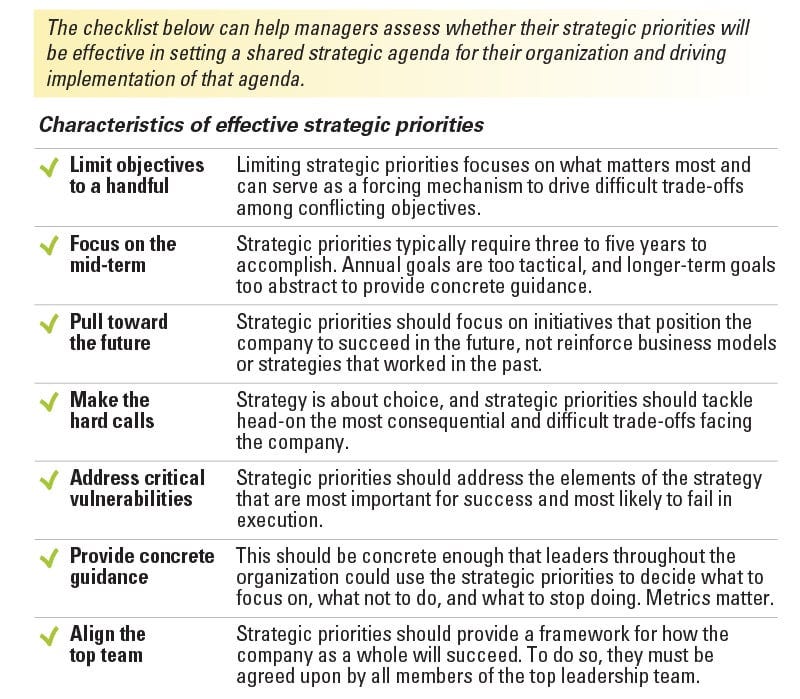
For writing clear and effective priorities, the article shared the advice below (and goes into more detail for each bullet point in the article):
In addition to the above, I also love to see organizations upskill, train, and educate employees on strategy creation and organizational alignment.
Very often, strategy and alignment knowledge stays in board rooms and senior leadership meetings, creating a very top-down funnel that can miss crucial organizational information. Intentionally or unintentionally, hoarding this information inhibits the full potential for strategic success.
I’ve seen a mix of scenarios at different companies:
An individual who is not the best option for a strategy/leadership/decision-making role, but who got there simply by having access to C-Suite information and discussions (or maybe due to relationships).
Fantastic leadership candidates who need training, upskilling, and access to C-Suite information to help foster their innate leadership talents. Additionally, middle managers ARE YOUR ALIGNED STRATEGY FRODOS (yes, Frodo from The Lord of the Rings - which I’m currently reading, but am only 20% of the way through, so this analogy may be wrong. Cool, but wrong). If you properly train and upskill them, and allow them an opportunity to learn about the larger strategy creation, they will help keep your strategy moving in the same direction. They will also be key informers on wtf is going on with your customers, teams, organization, and markets.
Some crazy Game of Thrones-like activity where leaders intentionally hoard information and push their own agendas because they’re playing a weird game where everything’s made up and the points don’t matter (well, the points are usually money and status). Typically, these folks have self-serving goals and (logically) though I understand why they’re acting this way I (existentially) think it’s silly. My feelings aside, research has shown that self-serving leadership actions are bad for the organization (though, culturally praised and enabled…at least in the US).
To this last point, the article sums up effective strategy creation by saying:
“Strategic priorities should lay out what matters for the company as a whole to win and should reflect the interdependencies among the choices. If senior executives pursue goals that aren’t aligned with one another, the disagreements will filter down the silos, and the various teams will work at cross-purposes.”
Which is why strategy cannot exist in a silo, it cannot stay in the board room, it cannot stay with executives - it must be aligned, implemented, and managed throughout the organization.
Conclusion, for now…
So, although this one MIT Sloan article and my humble Lord of the Rings-tinged thoughts argue that organizational alignment is necessary for effective strategies, our work is not finished.
You will not stop hearing about this from me. You will not stop hearing about this from the strategy research world. You will not stop hearing about this from the organizational alignment and Industrial Organizational Psychology world.
And, yes, we can AI the strategy + organizational alignment dyad to our heart’s content, but unless someone in the organization is managing the day-to-day strategy boat, there’s a huge chance of going off course.
It is critical for organizations to understand that assigning dedicated resources to this dynamic helps with their strategic end goals, whatever those may be.
🤖 diD I uSE AI tO WriTE tHiS?!?! 🤖
No, and then yes, and then no again. The idea to write this article truly came from the story about me and my business partner. When he sent me the MIT Sloan article, I plugged it into an AI platform to see what it said.
But, just as I always experience when using AI, when I read over the results I remembered nothing. Therefore, I could write about nothing.
So, I did the best thing I know how, and went back to my grad school days of printing off a paper copy so I could highlight and hand-write notes.
About three-quarters of the way through reading the article, my 3-year-old asked me to watch over his sick dinosaurs. I’m happy to report, they all made a speedy recovery, and I was able to finish reading the article.
Who says women can’t have it all. 🙄